← Back home

Backstory

It started with a cat, a cause, and one very intense week.

Before the design systems, SaaS workflows and product strategy, there was Marmite, Bootstrap, and someone willing to give me a chance.

Not yet — give me a week.

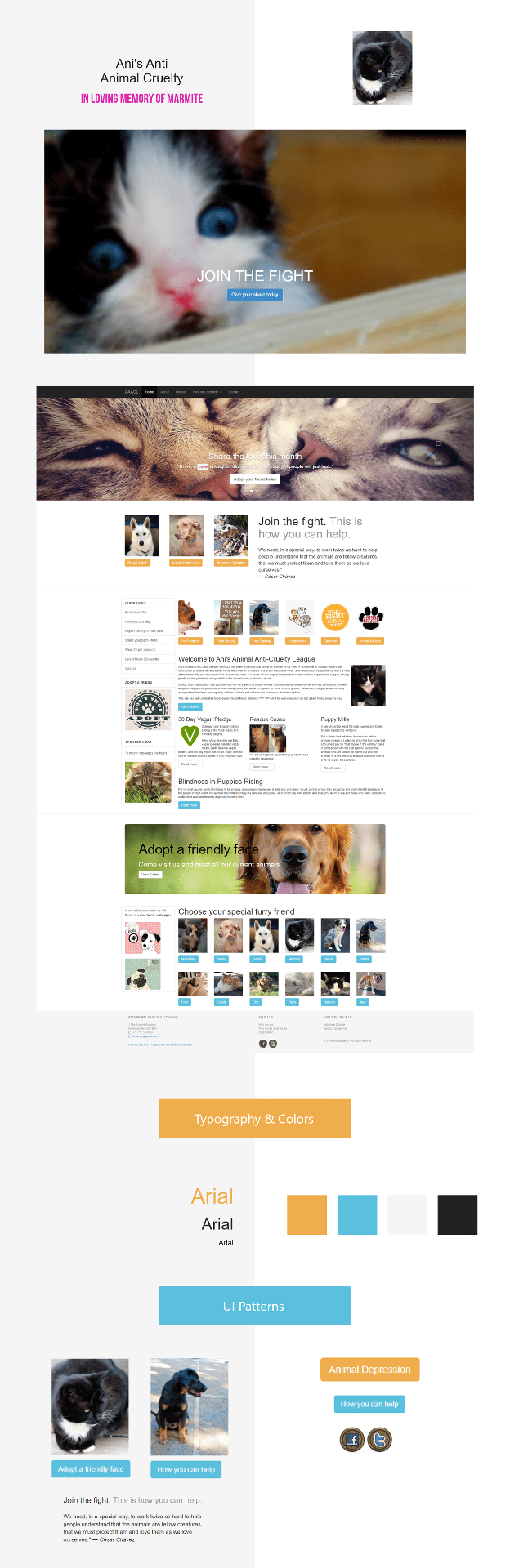
This was one of the first websites I ever designed and built.

It was called Ani’s Anti Animal Cruelty, created in loving memory of Marmite. I wanted to make something that could help rescue organisations, encourage adoption and give animals without a voice a little more visibility.

The problem was that I did not properly know how to build it yet.

So I taught myself Bootstrap in a week.

I learned how to structure pages, style components, make layouts behave and turn something that existed in my head into something another person could actually open in a browser.

Looking at it now, I can see everything I would redesign. The typography. The spacing. The responsiveness. The hierarchy. There is plenty I would change.

But I would never hide it.

Because this little website made someone believe in me enough to give me my first front-end design job at Dot Slash.

It changed the direction of my life.

And I think it explains more about me than a polished list of skills ever could.

The project that changed everything

Ani's Anti Animal Cruelty — the first website Niss designed and built, in memory of Marmite.

Ani’s Anti Animal Cruelty — built while teaching myself Bootstrap in one very intense week. It helped me land my first front-end design role at Dot Slash.

Would I redesign it now? Absolutely.

Would I remove it from my story? Never.

Chapter 01

The creative pull was there long before the job title

Before product design, there was a childhood dream of animation.

I loved drawing, writing, art and the feeling of making something from nothing. Life did not hand me a clean, shiny path into studying art, and I started working young because practicality had to come first.

But the creative pull never really left.

It became the little flame I kept returning to — the part of me that still wanted to make, shape and imagine even when the route forward was not obvious.

If the door closed, find the window.

That has always been my way of moving through life and work. If the traditional path was blocked, I looked for another way in — a side door, a tiny gap, a window I could squeeze through with enough curiosity and stubbornness.

Chapter 02

“Give me a week” became a bit of a pattern

I have never been especially good at accepting that I cannot do something simply because I have not done it before.

My response is usually:

Not yet — give me a week.

That does not mean pretending to know everything. It means being curious enough to learn, practical enough to start and stubborn enough to keep going until there is something real in front of us.

Around 2010 and 2011, coding cracked something open for me. WordPress, HTML and a well-used copy of HTML for Dummies became my side door into a world where ideas could become functional things.

I took on small pro bono projects to learn. I worked my way from administrative tasks into managing internal WordPress storefronts at The No Nonsense Group.

It was not glamorous.

It was not formal.

But it was mine.

When I later moved to Pretoria to be closer to family, I started searching for software companies nearby and reached out directly.

I did not have a polished portfolio or a traditional design qualification.

What I had was fire, curiosity and a willingness to learn quickly.

One week and one Bootstrap website later, Dot Slash gave me the chance that changed everything.

Chapter 03

The work home that shaped me

Dot Slash became more than my first front-end design job.

It became a work home, a mentorship space and the place where so much of the designer I would become started taking shape.

Before UX, UI and product design became the buzzwords they are now, we were already doing the work: figuring out flows, solving problems, building interfaces, challenging ideas and trying to make things make sense.

There were late nights, whiteboards, pizza, messy conversations and the kind of learning that happens when people take a chance on you and let you grow inside the work.

My front-end beginnings shaped me deeply.

I did not want to hand over a beautiful screen without understanding whether it could work. I wanted to know what happened after the design left the mockup. How components behaved. Why something broke. What developers needed. What users would experience when the ideal design met the real product.

I learned to care about the full shape of a product — not only how it looked, but how it behaved, how people understood it and where the friction quietly lived.

Chapter 04

I care more about the outcome than being right

I have strong opinions.

I also expect them to change when better information arrives.

My grandfather taught me one of the sentences I return to most:

What good is a mind if you can’t change it?

It follows me into design every day.

Stay open.

Rethink the obvious.

Change direction when the evidence changes.

Never become so attached to an answer that you stop listening.

I do not see critique as an attack on the work. Feedback gives us something useful to respond to.

I would rather test an idea, discover that it is wrong and rebuild it quickly than spend months protecting a beautiful assumption.

At Cash Connect, our team of three could spend hours on Zoom working through a problem, sometimes at completely unreasonable hours.

We flew to Durban, locked ourselves into a meeting room, covered blank paper with flows and assembled rough prototypes using sticky notes.

We drew, challenged, rearranged, tested and started again.

Nobody won by having the first idea.

We won when the experience became better.

The goal is not to protect the first solution.

The goal is to make the outcome stronger.

Chapter 05

The messy middle is still where I feel most useful

Over time, I became the person who gets pulled into messy systems.

The unclear workflow.

The awkward handoff.

The product logic that makes perfect sense internally but asks too much from the user.

The interface that looks complete but still leaves people unsure what to do next.

That is the messy middle.

It is where business requirements, technical constraints, user needs, support realities and a dozen competing opinions all arrive in the same room.

I learned that good design is not only about beautiful screens.

It is about reducing uncertainty.

It is about asking better questions, finding the real problem and helping teams move forward without losing the human on the other side.

It is also about staying calm when the room is not.

Chapter 06

My biggest loyalty is always to the person using the thing

I want products to feel so clear that people do not need a manual just to complete an ordinary task.

But I also know that good design does not mean pretending complexity no longer exists.

Sometimes the product genuinely needs education, reassurance and support.

That is why I loved building the Bluehook Resource Academy.

Useful training material already existed, but it was scattered and often depended on someone knowing what to send, when to send it and where it lived.

I helped turn it into a structured learning experience with clearer pathways and short how-to videos across mobile and desktop.

It taught me something I now believe deeply:

Product education is part of the user experience.

Designing the interface is only half the work if people still feel lost inside it.

Chapter 07

The projects I remember most are the ones that meant something

WombatWords

WombatWords remains one of those projects. I loved working on something that needed to support therapists professionally while still feeling encouraging, understandable and engaging for children.

It reminded me that design can make someone’s work easier while also making another person’s experience feel safer.

IDZ

IDZ was completely different and just as exciting. We were designing around a real wearable prototype — thinking about the relationship between the watch, the phone, physical interaction, trust and the ZCloud ecosystem behind it.

Being able to test ideas against an actual object made the work feel wonderfully tangible.

Cash Connect

Cash Connect showed me what product design can change when it reaches beyond a screen. Our small team helped move parts of a paper-led servicing environment into a connected digital product ecosystem — making customer information more accessible, workflows clearer and financial actions easier to understand.

The work still in motion

Then there are the ideas that are still in progress.

Cancer-treatment education. Eat the Rainbow, born from wanting to help my mom make sense of treatment and tracking. Lynka, shaped by the very real South African barriers of literacy, language, expensive data and limited access to smartphones.

I still want to create accessible UX/UI learning content for girls and young people who may not yet know that this career exists for them.

The ideas are not all finished. But I care enough about them that they keep returning.

Chapter 08

Remote work was never a temporary arrangement for me

I have worked remotely since 2016 — long before the world was forced to try it.

I built a proper home office because I knew this was how I worked best: a standing desk, an ergonomic chair, routines, reminders to move and enough structure to manage my own time without someone checking whether I am online every minute.

I have worked with international teams and planned around different time zones, including Canadian projects where a stand-up could begin at 8 p.m. South African time.

I am naturally introverted, which makes deep independent work comfortable for me.

But remote does not mean disconnected.

I will happily sit on a long call when the problem needs to be unpacked properly. I will present the thinking, invite criticism, challenge assumptions and stay until the team understands what is and is not working.

Freedom and responsibility make sense to me because I have been practising both for years.

Chapter 09

The softer reason behind the work

The deeper reason behind a lot of my work is simple:

I care about people who feel lost inside systems.

That shows up in B2B SaaS, product adoption, workflow UX and learning experiences.

It also shows up in the personal projects I keep returning to — especially patient education and healthcare communication.

When my mom went through cervical cancer treatment in a state facility, I saw how easily people can slip through the cracks when information is scattered, rushed or too hard to understand.

I had the time and stubbornness to research, ask, read, watch and advocate.

Not everyone has that person beside them.

That experience stayed with me.

It made the work feel bigger than interfaces.

It made me want to build things that help people understand what is happening, what comes next and what questions they are allowed to ask.
Make the scary thing smaller.

Make the messy thing clearer.

Leave people feeling a little less alone inside the system.

Chapter 10

The animals never really left the story

Ani’s Anti Animal Cruelty began with one deeply personal reason to care.

Today, I share my home with four cats and two dogs — all rescues.

So perhaps it is not surprising that I am still drawn to projects about access, education, health, care and making life a little less confusing for somebody.

I am more experienced now.

I understand product strategy, complex systems, research, design systems, adoption, content architecture and AI-assisted workflows.

But underneath all of that, I am still the same person who cared about something, did not fully know how to build it and decided to learn anyway.

Still curious. Still caring. Still likely to say, “Give me a week.”

I do not believe good work comes from pretending to know everything.

I think it comes from caring deeply, asking better questions, being willing to change your mind and taking enough responsibility to turn the thinking into something real.

I am not afraid to fail.

I am afraid of becoming too comfortable to try.

Still learning.

Still changing my mind.

Still finding the window.